Trusting the Universe
Whether on TV, in movies, on social media, podcasts, or in conversation, whatever the forum, no doubt you have heard statements like—
- The universe is guiding us
- Let the universe know your intentions
- The universe is our helper in life
- The universe has a plan for me, or the big one
- The universe brought Bill/Jill into my life
There seems to be a growing number of intelligent people who openly state a belief that “the universe” itself is an intelligent or responsive force that can guide us, arrange circumstances, send signs, answer requests, attract desired outcomes, or otherwise help direct our lives.
No doubt the universe—when seen through the eyes of powerful, modern telescopes and through the exploration of vehicles such as the Voyager spacecraft—is a grand and magnificent presence, stretching in all directions into what seems to be an endless eternity of galaxy-filled space.
But when someone makes a statement like, “I trust the universe,” what are they actually saying? What exactly are they trusting in? Is the universe intelligent? Does it have the power to think and change the course of a human life? Does it have a will or consciousness capable of hearing, answering, or guiding human activity?
Let’s take a deeper look.
What Is “the Universe”?
Before we can determine whether the universe can guide us, help us, or influence the course of our lives, perhaps we should first establish exactly what the universe is.
In the simplest terms, the universe is everything in the physical cosmos—space and time, galaxies, stars, planets, matter and energy (and an occasional black hole, like my old broadcast partner’s briefcase); all these together with the forces and physical laws by which they operate.
As we look more deeply into space, its extraordinary magnificence many times defies scientific understanding.
But magnificence does not equate with intelligence.
The universe itself does not have a mind, a personality or any demonstrated consciousness. A galaxy does not think. A star does not make decisions. Gravity does not know that you even exist.
So when we say that “the universe” knows what we need, gives us things, puts people into our lives, or has a plan for our future, we have moved beyond describing the physical universe. We have assigned to it the characteristics of a consciousness with meaning and purpose in its being.
If the universe itself cannot think, hear, know, choose or care, where did the idea come from that it can guide our lives?
How Did the Universe Become Our Helper?
The concept is not new, although some of the language surrounding it is. Today's ideas about “manifesting,” “putting your intentions into the universe,” and the “law of attraction” have roots in several philosophical and spiritual movements, particularly the New Thought movement of the nineteenth century and, later, various forms of New Age spirituality.
At the heart of these beliefs is the idea that our thoughts, intentions or attitudes somehow interact with a greater spiritual reality. In its popular modern form: focus your thoughts and intentions on what you desire, and you can help attract that desired result into your life—“name it and claim it.”
That might sound reassuring, offering the sense that there is something greater than ourselves at work and that perhaps we can tap into it.
But somewhere along the way, we gave a physical universe of stars, galaxies, matter and energy the ability to listen, respond, arrange circumstances and perhaps even care about what happens to us.
On what basis?
And for the Christian, there is an even more fundamental question: Have we attributed to the creation abilities that belong to the Creator?
The Creator and the Creation
For the Christian, the answer begins with the very first words of Scripture:
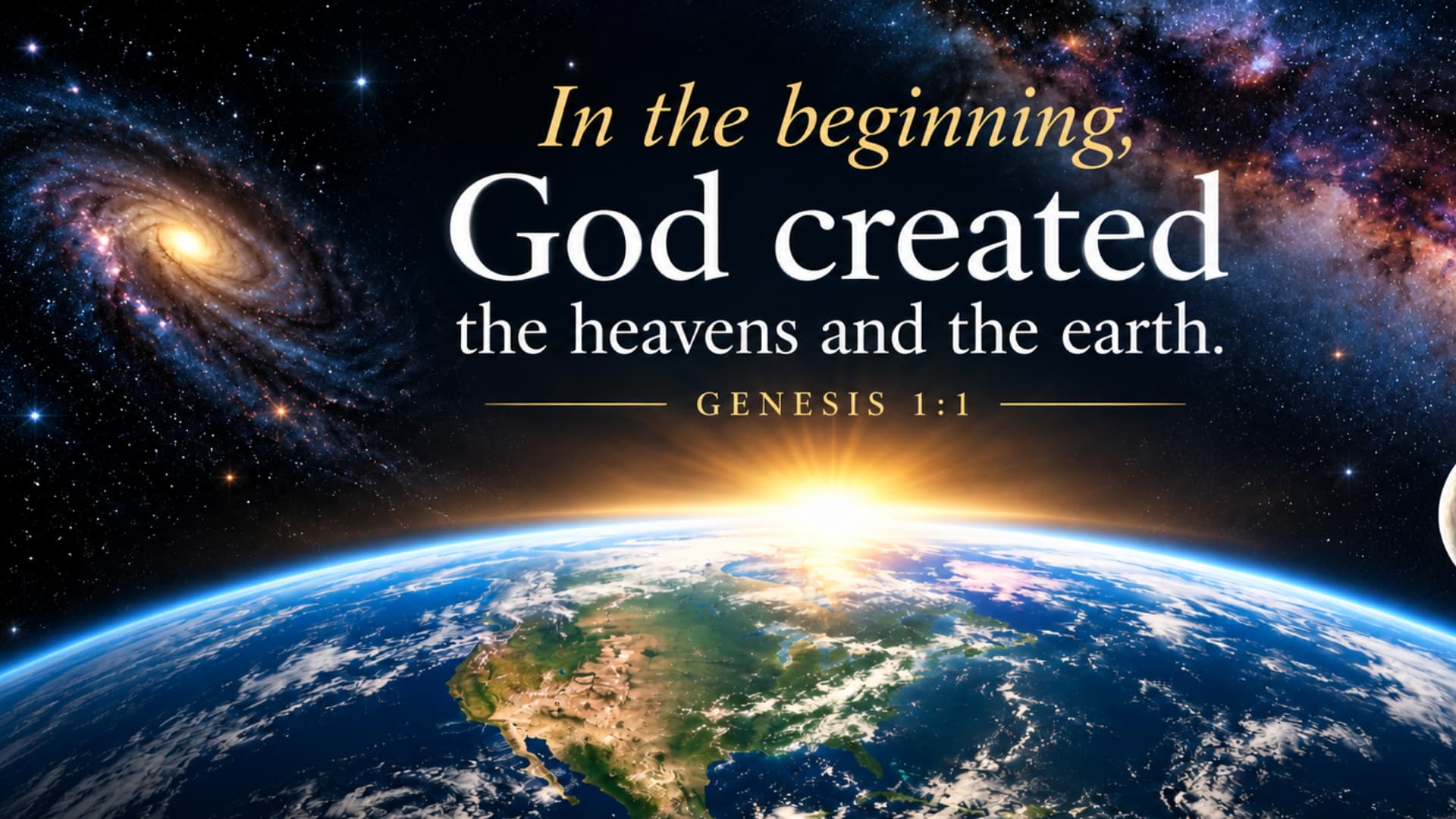
“In the beginning God created the heavens and the earth.” — Genesis 1:1
Those few words establish a distinction that runs throughout Scripture: God is the Creator. The universe is His creation.
Nowhere in the Bible is the universe described as an independent intelligence, spiritual force, or conscious presence capable of directing the affairs of men. Scripture presents the exact opposite.
The Apostle Paul writes that God's invisible attributes—His eternal power and divine nature—can be understood through what has been made (Romans 1:20).
Creation bears witness to something greater than itself.
Paul then warns of exchanging the truth of God for a lie and serving “the creature rather than the Creator” (Romans 1:25).
So when we attribute intelligence, guidance, provision, purpose and personal intervention to “the universe,” are we admiring creation—or assigning to creation qualities that belong to its Creator?
The One Behind the Universe
If the universe is not the source of the intelligence, purpose and power we seek, then where should we look?
The Bible does not leave that question unanswered.
John begins his Gospel with these words: “In the beginning was the Word, and the Word was with God, and the Word was God.” He then tells us, “All things came into being through Him, and apart from Him nothing came into being that has come into being.” (John 1:1, 3)
And then comes the revelation:
“And the Word became flesh, and dwelt among us…” (John 1:14)
The Creator entered His creation.
The One through whom the stars, galaxies and everything else came into existence is not an impersonal force somewhere in the vastness of space. Scripture reveals Him to us in the person of Jesus Christ.
So consider the contrast.
The universe cannot know you. God does.
The universe cannot hear you. God can.
The universe cannot love you. God does.
The universe cannot forgive you. God can.
And the universe cannot give you eternal life. Jesus Christ can.
But knowing that there is a Creator leaves us with one final and far more important question:
What is your relationship with Him?
The Bible tells us that the same Jesus Christ through whom all things came into being came into this world for us. And the heart of the Gospel is remarkably simple:
“Christ died for our sins according to the Scriptures, and … He was buried, and … He was raised on the third day according to the Scriptures.” — 1 Corinthians 15:3–4
Our hope, then, is not found by sending our intentions into the universe and waiting for the universe to respond. It is found in placing our faith in Jesus Christ—the One who created the universe, entered His creation, died for our sins, rose again, and offers eternal life to all who come to Him by grace through faith.
And Scripture makes the response personal:
“If you confess with your mouth Jesus as Lord, and believe in your heart that God raised Him from the dead, you will be saved.” — Romans 10:9
The universe may be magnificent beyond our comprehension.
But don't confuse the creation with the Creator.
Unless otherwise noted, all Scripture quotations are from the New American Standard Bible (NASB 2020).