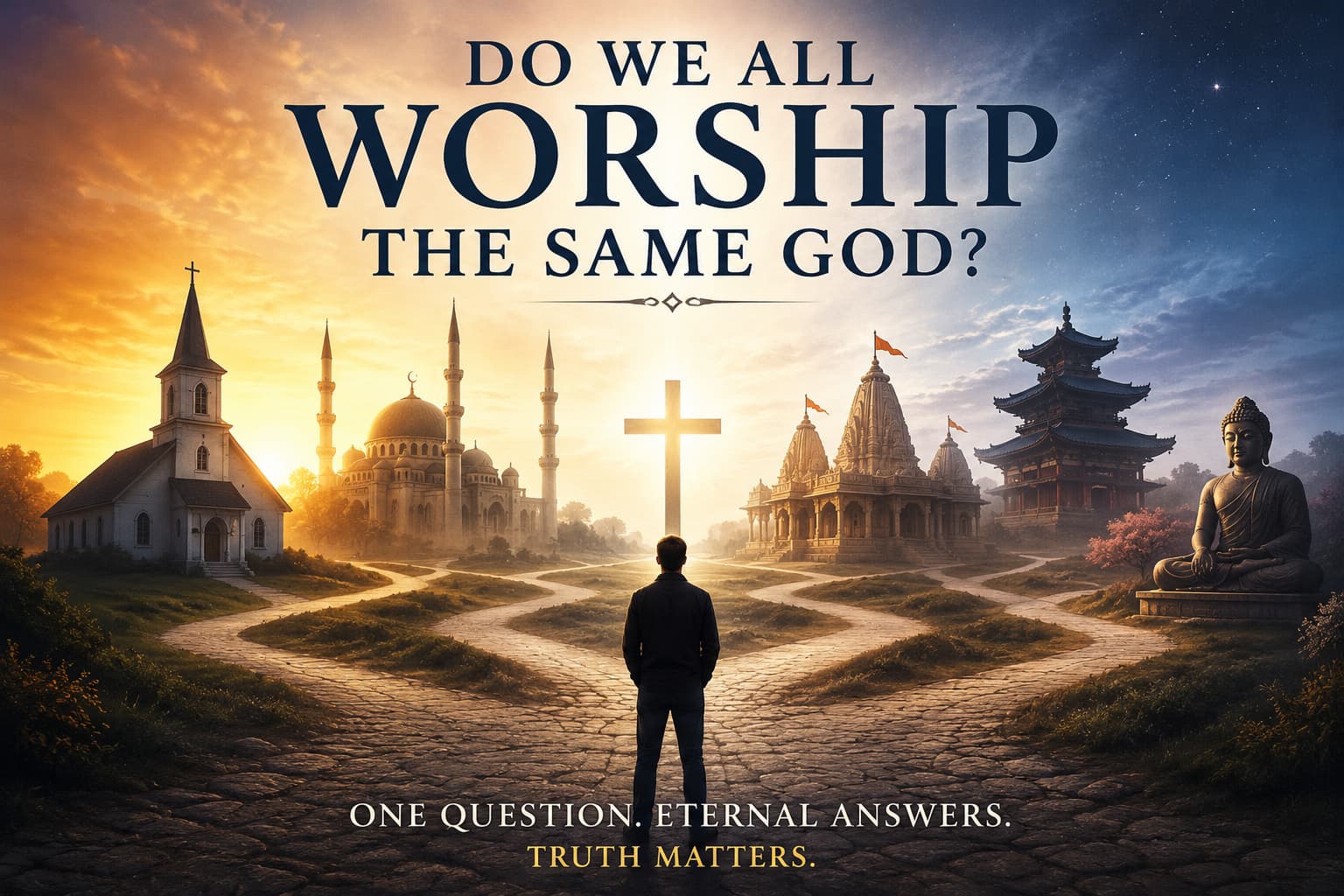
Do We All Worship the Same God?
Even as a born-again Christian, I had never seriously considered the question until I heard former President George W. Bush, while being interviewed by former ABC News commentator Charles Gibson, respond to this question:
“Do we all worship the same God—Christian and Muslim?”
It was a puzzling question, but President Bush seemingly had given it some thought.
“I think we do,” Bush replied. “We all have different routes of getting to the Almighty…” (video)
That answer raises a question of eternal importance.
Many of us in America and around the world would do well to examine carefully the belief system upon which we stake our eternal future—whether Christian, Jewish, Catholic, Muslim, Buddhist, Hindu, Mormon (LDS), Jehovah’s Witness, Agnostic, Atheist, or something else.
Are all of these simply different routes leading ultimately to the same God?
Everyone who shares President Bush’s view should seriously reconsider the assertion that Christians and Muslims worship the same God and that “we all have different routes of getting to the Almighty.”
Because if truth is absolute—and if our eternal destination depends upon whom we have believed—then this is not merely an academic or philosophical question.
Truth matters. And our faith in the true God has eternal consequences.
In that regard, there are ultimately only two destinations.
One is really good.
The other is... well, really not.
All of the world’s religions have particular beliefs concerning God, salvation, and life after physical death. Other contrasts may be considered elsewhere. But in this article, we will focus primarily upon the two belief systems addressed in that interview: Islam and Christianity.
Considering the Contrast
As we consider the contrast, we should begin with a fundamental question:
Is it possible for the sovereign God to contradict Himself?
Consider what Scripture says:
“Jesus Christ is the same yesterday and today, and forever.”Hebrews 13:8 (NASB)
“Of old You founded the earth,
And the heavens are the work of Your hands.
Even they will perish, but You endure;
And all of them will wear out like a garment;
Like clothing You will change them and they will be changed.
But You are the same,
And Your years will not come to an end.” Psalm 102:25–27 (NASB)
“For I, the LORD, do not change; therefore you, the sons of Jacob, have not come to an end.” Malachi 3:6 (NASB)
The biblical testimony is clear: God does not change.
What Does the Scripture Say?
Considering these passages, the question remains:
Would God change His revelation concerning Himself—and particularly concerning His Son—to accommodate a belief system that appeared centuries later?
God has been God from eternity past. By contrast, Islam began to emerge around A.D. 610, in the seventh century—some 4,600 years after creation according to the biblical chronology used here, and nearly six centuries after the earthly ministry, death, burial, and resurrection of Jesus Christ.
That chronology becomes especially significant when we remember that centuries before the emergence of Islam, the apostle Paul had already written this warning:
“But even if we, or an angel from heaven, should preach to you a gospel contrary to what we have preached to you, he is to be accursed! As we have said before, so I say again now, if anyone is preaching to you a gospel contrary to what you received, he is to be accursed!” Galatians 1:8–9 (NASB)
Paul’s warning came in the first century.
Islam emerged in the seventh century.
And Islam teaches that Muhammad received revelation through the angel Gabriel.
That chronological and theological contrast deserves careful consideration.
So let us examine some of the principal claims side by side.
Islam Says... / Christianity Says...
God
There is one God, Allah, Creator and Sustainer of all things. The Shahada, Islam’s declaration of faith and first of its Five Pillars, begins with the profession that there is no deity but God.
There is one God, eternally existing as Father, Son, and Holy Spirit. Christianity therefore does not teach three gods, but one God in three distinct Persons.
Jesus commanded His disciples to baptize “in the name of the Father and the Son and the Holy Spirit” (Matthew 28:19).
John 1:1–4 identifies the Word as God and declares that all things came into being through Him.
Here we encounter one of the fundamental differences between Islam and Christianity: the identity of Jesus Christ.
The Messenger
The Shahada identifies Muhammad as the messenger of God. Muslims regard Muhammad as a prophet who received divine revelation.
The New Testament identifies Jesus not merely as a messenger from God, but as the Christ, the Son of God, the Savior, the giver of eternal life, and God revealed in human flesh.
John 20:31 says these things were written so that we may believe Jesus is the Christ, the Son of God, and by believing have life in His name.
That is not a minor theological difference. It goes directly to the question of who God is.
Prayer
Salat—the practice of ritual prayer five times each day—is the second of Islam’s Five Pillars.
The New Testament does not prescribe five specific daily prayer times for Christians. Instead, believers are told to rejoice always, pray without ceasing, and give thanks in everything (1 Thessalonians 5:16–18).
Christian prayer is therefore presented not merely as an appointed ritual, but as an ongoing relationship and communion with God.
Pilgrimage
Hajj, pilgrimage to Mecca for those physically and financially able to make it, is one of Islam’s Five Pillars.
The New Testament contains no corresponding command requiring Christians to make a pilgrimage to Jerusalem, Israel, or any other earthly location.
Christians certainly may visit the lands in which biblical events occurred, but such a journey has no part in obtaining salvation or establishing a believer’s standing before God.
Salvation
Islam emphasizes submission to God, faith, righteous conduct, obedience, repentance, and ultimately the mercy and judgment of Allah.
Salvation cannot be earned by religious observance or human merit.
“For by grace you have been saved through faith; and this is not of yourselves, it is the gift of God; not a result of works, so that no one may boast” (Ephesians 2:8–9, NASB).
Christian salvation is therefore not mankind climbing upward toward God through sufficient works. It is God reaching downward to mankind in grace.
Revelation
Muslims believe that Muhammad received revelations from God through the angel Gabriel, beginning in the seventh century.
Centuries earlier, the apostle Paul had warned that even “an angel from heaven” preaching a gospel contrary to the one already received was to be rejected (Galatians 1:8–9).
The significance should not be overlooked. The New Testament Gospel had already been proclaimed. Paul had already warned the Church against accepting a contrary gospel—even if its purported source were an angel from heaven.
Then, centuries later, another message appeared claiming angelic revelation while contradicting foundational Christian teaching concerning Jesus Christ.
The reader must decide what to make of that.
The Central Question: Who Is Jesus?
Ultimately, this entire discussion comes down to one Person:
Jesus Christ.
Christianity teaches that Jesus Christ is the eternal Son of God, God manifested in the flesh, the Creator, the Savior of mankind, the One who died for our sins, was buried, rose bodily from the dead, and is the only way to the Father.
“I am the way, and the truth, and the life; no one comes to the Father except through Me.” John 14:6 (NASB)
Islam honors Jesus as an important figure and prophet, but it does not worship Him as God the Son in the Christian understanding.
These two positions cannot simultaneously describe the same truth about the identity of Jesus.
Jesus cannot both be God and not be God in the same sense.
He cannot simultaneously be the only way to the Father while there are other, contradictory ways to the Father.
God cannot contradict Himself.
Do We All Worship the Same God?
If Christians worship Jesus Christ as God—and Islam does not worship Jesus Christ as God—then the reasonable, logical, and rational conclusion is:
Christians and Muslims do not worship the same God as He is revealed in the Christian Scriptures.
The differences are not simply cultural.
They are not merely differences in terminology.
And they are not simply different roads leading to the same destination.
They concern the very identity and nature of God, the Person of Jesus Christ, the Gospel, and the means by which mankind receives eternal life.
And Scripture leaves no ambiguity concerning where eternal life is found:
“And the testimony is this, that God has given us eternal life, and this life is in His Son. The one who has the Son has the life; the one who does not have the Son of God does not have the life. These things I have written to you who believe in the name of the Son of God, so that you may know that you have eternal life.” 1 John 5:11–13 (NASB)
It is a question with eternal consequences.